Showing posts with label odes. Show all posts

Wednesday, July 1, 2026

Appeal / John Frederic Herbin


Crisco 1492,  Great Canadian Flag, Windsor, ON, 2025-06-22.  CC BY SA 4.0, Wikimedia Commons.

Appeal

Canadians! raise aloft your country’s flag,
Nor low to earth, nor lifeless see it drag.
Up! till each sign in gentle winds unread,
Meets breezes strong, and every fold is spread.
Its place is high, above the feeble gust
That dims its color with a servile dust.
Among the storms, there see it proudly move
The emblem of your country and your love —
Where all its noble length becomes unfurled
By winds that shake the proudest of the world.
Then will the nations read upon its face,
Whatever, once, their country and their race,
One hope and one ambition closely tie
This people to a common destiny.

A bond of kindred makes your pulses beat,
Frank, Saxon, Kelt, with triple force and heat;
Your veins no longer separate currents run,
Your hearts now animate and beat as one.
Oh noble land and nation! growing strong,
One sky and flag is yours, whatever tongue.
To hold and crown your rampart and your hall
With zeal and valour, needs the strength of all.
My countrymen, your fathers’ valiant swords,
Their kings’ decrees, their sages’ golden words,
The world through cycles down have ruled and led —
A rich inheritance comes from the dead.
Their wisdom and their light are for your hand,
Blessed with the rule of this most fruitful land.

Thick years will come, sprung from the seed you sow;
And for those harvest-days that quickly flow,
The nation walks a-field casting the seed
Of worth and power, the future’s urgent need.
The sun of progress shines; and day full blest
And loud with labor from the east and west,
Hangs over you. Across the western sea,
Mankind new-born obeyed its destiny,
Wandering westward like a current’s trend;
In Canada the roadway hath its end.
The marching centuries of tribe and race
Around the earth, on this find halting-place.

Toward either coast the ocean currents glide;
Upon their waves your sailors homeward ride.
No mimic ships are yours, the keels are deep;
Your sons are brave when angry waters leap.
A man is this whose axe doth clear the ground;
And where he smites the forest tumbles round.
This is a warrior, the first to bleed,
The foremost in the rank of noble deed.
At helm, with axe, before the foemen’s guns,
You live and die your fathers’ worthy sons.
Proud of your flag, see! how your praises swing
It straight and clear, to nations heralding.

~~
John Frederic Herbin (1860-1923)
from Canada, and other poems, 1891

[Poem is in the public domain in Canada, the United States, and the European Union]

Sunday, May 4, 2025

Song on May Morning / John Milton


Song on May Morning

Now the bright morning Star, Dayes harbinger,
Comes dancing from the East, and leads with her
The Flowry May, who from her green lap throws
The yellow Cowslip, and the pale Primrose.
    Hail bounteous May that dost inspire
    Mirth and youth, and warm desire,
    Woods and Groves, are of thy dressing,
    Hill and Dale, doth boast thy blessing.
Thus we salute thee with our early Song,
    And welcom thee, and wish thee long.

~~
John Milton (1608-1674)
from
Poetical Works, 1900

[Poem is in the public domain worldwide]


"Song on May Morning" read by Tom Kinsella. Courtesy LITT at Stockton.

Friday, March 21, 2025

Spring: An ode / Jane West


Spring: An ode

And now, obedient to divine command,
Reluctant winter yields his rigid reign;
Exulting Nature breaks his cruel band,
And welcomes Flora to her old domain;
She from her chariot strews ambrosial flowers;
'Tis she, that decks the vales, and renovates the bowers.

The pendent icicle perceives the thaw,
Then quits the straw-roof'd cot, and melts away;
The snow beholds, and hastens to withdraw,
But loses first its innocent array:
Assuming now, a robe of murky hue
More soil'd, as more receding from our view.

Ice in its northern magazine lies chain'd,
And all the furious hurricanes are bound;
Zephyr, by Eurus fierce too long restrain'd,
Now claps his pinions at the joyful sound;
The gentle shower descends; earth opens wide
Her jaws, and thirsty sucks the copious tide.

The glorious sun with vegetative powers
Endues the air, resolving to unchain
The willing world, while in his noon-tide hours:
Well knowing, that his sister Queen again,
When she resum'd her silver throne, would freeze
The brooks and rills, and hardly spare the seas.

And now alternate, what bright Phoebus thaws
By day, by night the Queen of shade congeals:
Nature, subservient to discordant laws,
In all her springs the dire commotion feels:
The bud, that noon-tide suns inspir'd to rise,
Lies dead at evening, chill'd by frosty skies.

Mid the confusion, whilst we scarce can tell
If winter stays or flies, the snow-drop rears
Her humid head, and fills each drooping bell
With incense pure and odoriferous tears:
Safe in its native innocence it stands,
Nor dreads keen Boreas, nor the wintry bands.

Yet, but a herald to the crocus proud,
Who peers a King in golden arms array'd,
Around him daffodils and violets crowd,
And primroses dear to the wood-land maid;
Succeeded quickly by a thousand flowers,
All that delight in meadows, hills, and bowers.

Behold, the elm puts on its dark array
Of dusky green; forth shoots the alder dun;
In the light breeze the leaves of aspin play;
The bushy sycamore desires the sun;
And last, as if the sylvan band to close,
The regal oak his ample foliage shows.

But see, the young creation is awake;
The household bee forsakes her waxen cell;
The finny nations wanton in the lake;
The gentle birds their pleasing descants tell;
The lordly steed indignant paws the ground;
And o'er green thymy banks the lambkins bound.

And now the etherial ram the zenith leaves,
The ram of old surcharg'd with Helle's fate;
This, the proud bull, his rival stern, perceives,
And issue forth in all his radiant state,
He bends his starry horns, enwreath'd with light,
As if to rend the dusky veil of night.

The blessed sun his beams benignly pours
On the glad earth, and bids creation smile:
Exuberant nature pours forth all her stores,
And chearful swains renew their annual toil:
War too, by intermission unsubdu'd,
Resumes its rage for violence and blood!

But that I fear my mortal muse would faint,
And leave me aidless in th' unbounded space,
My song the starry firmament should paint,
How planets run their vast eliptic race,
Arcturus urging on his starry team,
Orion's sword, and Ursa's guiding beam.

But let me stop the thought, nor strive to rein
This fiery steed, nor compass heights divine;
Lest I, dismounted on the Lycian plain,
Mourn like Bellerophon the rash design;
Enough that I with rude and doric strain,
Oh genial spring! have hail'd thy welcome reign.

~~
Jane West (1756-1852)
from
Miscellaneous Poems, 1786

[Poem is in the public domain worldwide
]

Jane West biography

Workshop of Jan Brueghel the Elder (1568–1625) & Hendrick van Balen the Elder (1573–1632),
Flora im Blumengarten, circa 1617-1618 (detail). Wikimedia Commons.

Monday, November 11, 2024

How Sleep the Brave / William Collins


Ode

How sleep the brave who sink to rest
By all their country's wishes blest!
When Spring, with dewy fingers cold,
Returns to deck their hallow'd mold,
She there shall dress a sweeter sod
Than Fancy's feet have ever trod.

By fairy hands their knell is rung,
By forms unseen their dirge is sung;
There Honor comes, a pilgrim gray,
To bless the turf that wraps their clay;
And Freedom shall awhile repair,
To dwell a weeping hermit there!

~~
William Collins (1721-1759), 1746 
from Poems, 1898

[Poem is in the public domain worldwide]


"How Sleep the Brave" read by Joshua David Robinson. Courtesy  Lincoln’s Cottage .

Saturday, October 12, 2024

On a Thrush Singing in Autumn / Lewis Morris


On a Thrush Singing in Autumn

Sweet singer of the Spring, when the new world
Was fill’d with song and bloom, and the fresh year
Tripp’d, like a lamb playful and void of fear,
Through daisied grass and young leaves scarce unfurl’d,
Where is thy liquid voice
That all day would rejoice?
Where now thy sweet and homely call,
Which from grey dawn to evening’s chilling fall
Would echo from thin copse and tassell’d brake,
For homely duty tuned and love’s sweet sake?

The spring-tide pass’d, high summer soon should come.
The woods grew thick, the meads a deeper hue;
The puipy summer growths swell’d, lush and tall;
The sharp scythes swept at daybreak through the dew.
Thou didst not heed at all,
Thy prodigal voice grew dumb;
No more with song mightst thou beguile,
— She sitting on her speckled eggs the while —
Thy mate’s long vigil as the slow days went,
Solacing her with lays of measureless content.

Nay, nay, thy voice was Duty’s, nor would dare
Sing were Love fled, though still the world were fair;
The summer wax’d and waned, the nights grew cold,
The sheep were thick within the wattled fold,
The woods began to moan,
Dumb wert thou and alone;
Yet now, when leaves are sere, thy ancient note
Comes low and halting from thy doubtful throat.
Oh, lonely loveless voice! what dost thou here
In the deep silence of the fading year?

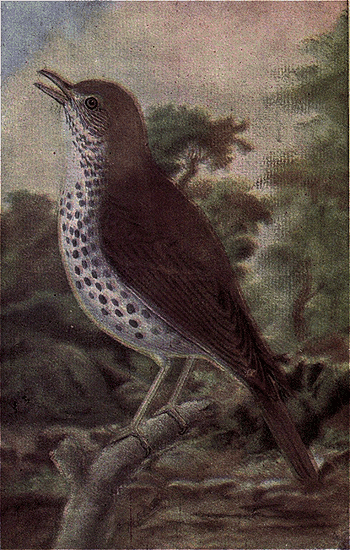
Wood Thrush. From 
Chester A. Reed,
The Bird Book1915.

Thus do I read the answer of thy song:
‘I sang when winds blew chilly all day long;
I sang because hope came and joy was near,
I sang a little while, I made good cheer;
In summer’s cloudless day
My music died away;
But now the hope and glory of the year
Are dead and gone, a little while I sing
Songs of regret for days no longer here,
And touched with presage of the far-off Spring.’

Is this the meaning of thy note, fair bird?
Or do we read into thy simple brain
Echoes of thoughts which human hearts have stirred,
High-soaring joy and melancholy pain?
Nay, nay, that lingering note
Belated from thy throat —
‘Regret,’ is what it sings, ‘regret, regret!
The dear days pass, but are not wholly gone.
In praise of those I let my song go on;
’Tis sweeter to remember than forget.’

~~
Lewis Morris (1833-1907)
from
Songs of Britain, 1887

[Poem is in the public domain worldwide]

Lewis Morris biography

See also: "The Thrush" by Edward Thomas

Saturday, May 25, 2024

Ode in May / William Watson


Ode in May

Let me go forth, and share
The overflowing Sun
With one wise friend, or one
Better than wise, being fair,
Where the pewit wheels and dips
On heights of bracken and ling,
And Earth, unto her leaflet tips,
Tingles with the Spring.

What is so sweet and dear
As a prosperous morn in May,
The confident prime of the day,
And the dauntless youth of the year,
When nothing that asks for bliss,
Asking aright, is denied,
And half of the world a bridegroom is,
And half of the world a bride?

The Song of Mingling flows,
Grave, ceremonial, pure,
As once, from lips that endure,
The cosmic descant rose,
When the temporal lord of life,
Going his golden way,
Had taken a wondrous maid to wife
That long had said him nay.

For of old the Sun, our sire,
Came wooing the mother of men,
Earth, that was virginal then,
Vestal fire to his fire.
Silent her bosom and coy,
But the strong god sued and press'd;
And born of their starry nuptial joy
Are all that drink of her breast.

And the triumph of him that begot,
And the travail of her that bore,
Behold they are evermore
As warp and weft in our lot.
We are children of splendour and flame,
Of shuddering, also, and tears.
Magnificent out of the dust we came,
And abject from the Spheres.

O bright irresistible lord!
We are fruit of Earth's womb, each one,
And fruit of thy loins, O Sun,
Whence first was the seed outpour'd.
To thee as our Father we bow,
Forbidden thy Father to see,
Who is older and greater than thou, as thou
Art greater and older than we.

Thou art but as a word of his speech;
Thou art but as a wave of his hand;
Thou art brief as a glitter of sand
'Twixt tide and tide on his beach;
Thou art less than a spark of his fire,
Or a moment's mood of his soul:
Thou art lost in the notes on the lips of his choir
That chant the chant of the Whole.

~~
William Watson (1858-1935)
from
Collected Poems, 1899

[Poem is in the public domain in Canada, the United States, and the European Union]


Michal Klajban, Sun getting through fog in the New Zealand Bush, 2019 (detail). 

Sunday, March 10, 2024

March: An ode / A.C. Swinburne


March: An Ode

    I


Ere frost-flower and snow-blossom faded and fell, and the splendour of 
    winter had passed out of sight,
The ways of the woodlands were fairer and stranger than dreams that 
    fulfil us in sleep with delight;
The breath of the mouths of the winds had hardened on tree-tops and 
    branches that glittered and swayed
Such wonders and glories of blossomlike snow or of frost that outlightens 
    all flowers till it fade
That the sea was not lovelier than here was the land, nor the night than 
    the day, nor the day than the night,
Nor the winter sublimer with storm than the spring: such mirth had the 
    madness and might in thee made,
March, master of winds, bright minstrel and marshal of storms that 
    enkindle the season they smite.

    II

And now that the rage of thy rapture is satiate with revel and ravin and 
    spoil of the snow,
And the branches it brightened are broken, and shattered the tree-tops 
    that only thy wrath could lay low,
How should not thy lovers rejoice in thee, leader and lord of the year that 
    exults to be born
So strong in thy strength and so glad of thy gladness whose laughter puts 
    winter and sorrow to scorn?
Thou hast shaken the snows from thy wings, and the frost on thy forehead 
    is molten: thy lips are aglow
As a lover's that kindle with kissing, and earth, with her raiment and 
    tresses yet wasted and torn,
Takes breath as she smiles in the grasp of thy passion to feel through her 
    spirit the sense of thee flow.

    III

Fain, fain would we see but again for an hour what the wind and the sun 
    have dispelled and consumed,
Those full deep swan-soft feathers of snow with whose luminous burden 
    the branches implumed
Hung heavily, curved as a half-bent bow, and fledged not as birds are, but 
    petalled as flowers,
Each tree-top and branchlet a pinnacle jewelled and carved, or a fountain 
    that shines as it showers,
But fixed as a fountain is fixed not, and wrought not to last till by time or 
    by tempest entombed,
As a pinnacle carven and gilded of men: for the date of its doom is no 
    more than an hour's,
One hour of the sun's when the warm wind wakes him to wither the snow-
    flowers that froze as they bloomed.

    IV

As the sunshine quenches the snowshine; as April subdues thee, and 
    yields up his kingdom to May;
So time overcomes the regret that is born of delight as it passes in passion 
    away,
And leaves but a dream for desire to rejoice in or mourn for with tears or 
    thanksgivings; but thou,
Bright god that art gone from us, maddest and gladdest of months, to 
    what goal hast thou gone from us now?
For somewhere surely the storm of thy laughter that lightens, the beat of 
    thy wings that play,
Must flame as a fire through the world, and the heavens that we know not 
    rejoice in thee: surely thy brow
Hath lost not its radiance of empire, thy spirit the joy that impelled it on 
    quest as for prey.

    V

Are thy feet on the ways of the limitless waters, thy wings on the winds of 
    the waste north sea?
Are the fires of the false north dawn over heavens where summer is 
    stormful and strong like thee
Now bright in the sight of thine eyes? are the bastions of icebergs assailed 
    by the blast of thy breath?
Is it March with the wild north world when April is waning? the word that 
    the changed year saith,
Is it echoed to northward with rapture of passion reiterate from spirits 
    triumphant as we
Whose hearts were uplift at the blast of thy clarions as men's rearisen 
    from a sleep that was death
And kindled to life that was one with the world's and with thine? hast thou 
    set not the whole world free?

    VI

For the breath of thy lips is freedom, and freedom's the sense of thy spirit, 
    the sound of thy song,
Glad god of the north-east wind, whose heart is as high as the hands of thy 
    kingdom are strong,
Thy kingdom whose empire is terror and joy, twin-featured and fruitful of 
    births divine,
Days lit with the flame of the lamps of the flowers, and nights that are 
    drunken with dew for wine,
And sleep not for joy of the stars that deepen and quicken, a denser and 
    fierier throng,
And the world that thy breath bade whiten and tremble rejoices at heart as 
    they strengthen and shine,
And earth gives thanks for the glory bequeathed her, and knows of thy 
    reign that it wrought not wrong.

    VII

Thy spirit is quenched not, albeit we behold not thy face in the crown of 
    the steep sky's arch,
And the bold first buds of the whin wax golden, and witness arise of the 
    thorn and the larch:
Wild April, enkindled to laughter and storm by the kiss of the wildest of 
    winds that blow,
Calls loud on his brother for witness; his hands that were laden with 
    blossom are sprinkled with snow,
And his lips breathe winter, and laugh, and relent; and the live woods feel 
    not the frost's flame parch;
For the flame of the spring that consumes not but quickens is felt at the 
    heart of the forest aglow,
And the sparks that enkindled and fed it were strewn from the hands of 
    the gods of the winds of March.

~~
A.C. Swinburne (1837-1909)
from Poems and Ballads, Third series, 1889

[Poem is in the public domain worldwide]

A.C. Swinburne biography

"March: An Ode" read by Richard Mitchley. Courtesy The Orchard Enterprises.

Sunday, May 21, 2023

Ode on the Spring / Thomas Gray


Ode

Lo! where the rosy-bosom'd Hours,
Fair Venus' train appear,
Disclose the long-expecting flowers,
And wake the purple year!
The Attic warbler pours her throat,
Responsive to the cuckoo's note,
The untaught harmony of spring:
While whisp'ring pleasure as they fly,
Cool zephyrs thro' the clear blue sky
Their gather'd fragrance fling.

Where'er the oak's thick branches stretch
A broader, browner shade;
Where'er the rude and moss-grown beech
O'er-canopies the glade,
Beside some water's rushy brink
With me the Muse shall sit, and think
(At ease reclin'd in rustic state)
How vain the ardour of the crowd,
How low, how little are the proud,
How indigent the great!

Still is the toiling hand of Care:
The panting herds repose:
Yet hark, how thro' the peopled air
The busy murmur glows!
The insect youth are on the wing,
Eager to taste the honied spring,
And float amid the liquid noon:
Some lightly o'er the current skim,
Some show their gaily-gilded trim
Quick-glancing to the sun.

To Contemplation's sober eye
Such is the race of man:
And they that creep, and they that fly,
Shall end where they began.
Alike the busy and the gay
But flutter thro' life's little day,
In fortune's varying colours drest:
Brush'd by the hand of rough Mischance,
Or chill'd by age, their airy dance
They leave, in dust to rest.

Methinks I hear in accents low
The sportive kind reply:
Poor moralist! and what art thou?
A solitary fly!
Thy joys no glitt'ring female meets,
No hive hast thou of hoarded sweets,
No painted plumage to display:
On hasty wings thy youth is flown;
Thy sun is set, thy spring is gone —
We frolic, while 'tis May.

~~
Thomas Gray (1716-1771)
from Poems by Mr. Gray, 1768

[Poem is in the public domain worldwide]

Thomas Gray biography 

"Ode on the Spring" read by Richard Mitchley. Courtesy YouTube.

Sunday, March 13, 2022

Beeny Cliff / Thomas Hardy


Beeny Cliff

March 1870 - March 1913

    I

O the opal and the sapphire of that wandering western sea,
And the woman riding high above with bright hair flapping free –
The woman whom I loved so, and who loyally loved me.

    II

The pale mews plained below us, and the waves seemed far away
In a nether sky, engrossed in saying their ceaseless babbling say,
As we laughed light-heartedly aloft on that clear-sunned March day.

    III

A little cloud then cloaked us, and there flew an irised rain,
And the Atlantic dyed its levels with a dull misfeatured stain,
And then the sun burst out again, and purples prinked the main.

    IV

– Still in all its chasmal beauty bulks old Beeny to the sky,
And shall she and I not go there once again now March is nigh,
And the sweet things said in that March say anew there by and by?

    V

What if still in chasmal beauty looms that wild weird western shore,
The woman now is – elsewhere – whom the ambling pony bore,
And nor knows nor cares for Beeny, and will laugh there nevermore.

~~
Thomas Hardy (1840-1928)
from Satires of Circumstance, 1914

[Poem is in the public domain in Canada, the United States, and the European Union]

Sunday, December 20, 2020

On the Winter Solstice / Mark Akenside


Ode II. On the Winter Solstice,  MD.CC.XL

The radiant ruler of the year
At length his wintry goal attains,
Soon to reverse the long career,
And northward bend his golden reins.
Prone on Potosi's haughty brow
His fiery streams incessant flow,
Prone rush the fiery floods of light
Ripening the silver's ductile stores;
While, in the cavern's horrid shade,
The panting Indian hides his head,
And oft th'approach of eve implores.

But lo, on this deserted coast
How pale the light! how thick the air!
Lo, armed with whirlwind, hail, and frost,
Fierce winter desolates the year.
The fields resign their cheerful bloom;
No more the breezes waft perfume,
No more the warbling waters roll:
Deserts of snow fatigue the eye,
Black storms involve the louring sky,
And gloomy damps oppress the soul.

Now through the town promisuous throngs
Urge the warm bowl and ruddy fire:
Harmonious dances, festive songs
To charm the midnight hours conspire.
While mute and shrinking with her fears,
Each blast the cottage-martron hears,
As o'er the hearth she sits alone:
At morn her bridgroom went abroad,
The night is dark and deep the road;
She sighs and wishes him at home.

But thou, my lyre, awake, arise,
And hail the sun's remotest ray:
Now, now he climbs the northern skies,
To-morrow nearer than today.
Then louder howl the stormy waste,
Be land and ocean worse defac'd,
Yet brighter hours are on the wing;
And fancy thro' the wintry glooms,
All fresh with dews and opening blooms,
Already hails th' emerging spring.

O fountain of the golden day!
Could mortal vows but urge thy speed,
How soon before thy vernal ray
Should each unkindly damp recede!
How soon each hovering tempest fly,
that now fermenting loads the sky,
Prompt on our heads to burst amain,
To rend the forest from the steep,
Or thundering o'er the Baltic deep,
To whelm the merchant's hopes of gain!

But let not man's unequal views
Presume on nature and her laws:
'Tis his with grateful joy to use
Th' indulgence of the sov'reign cause;
Secure that health and beauty springs
Thro' this majestic frame of things,
Beyond what he can reach to know,
And that heav'n's all-subduing will,
With good the progeny of ill,
Attempers every state below.

How pleasing wears the wintry night,
Spent with the old illustrious dead!
While, by the taper's trembling light,
I seem those awful courts to tread
Where chiefs or legislators lie,
Whose triumphs move before my eye
With every laurel fresh-displayed;
While now I taste th' Ionian song,
Or bend to Plato's godlike tongue
Resounding through the olive shade.

But if the gay, well-natur'd friend
Bids leave the studious page awhile,
Then easier joys the foul unbend
And teach the brow a softer smile;
Then while the genial flass is paid
By each to her, that faires maid,
Whose radiant eyes his hopes obey,
What lucky vows his bosom warm!
While absence heightens every charm,
And love invokes returning May!

May! thou delight of heav'n and earth,
When will thy happy morn arise
When the dear place which gives her birth
Restore LUCINDA to my eyes?
There while she walks the wonted grove,
The seat of music and of love,
Bright as the one primeval fair,
Thither, ye silver-sounding lyres,
Thither, gay smiles and young desires,
Chast hope and mutual faith repair.

And if believing love can read
The wonted fortunes in her eye,
Then shall my fears, O charming maid,
And every pain of absence die:
Then ofter to thy name attun'd,
And rising to diviner sound,
I'll wake the free Horatian song:
Old Tyne shall listen to my tale,
And Echo, down the bordering vale,
The liquid melody prolong.

~~
Mark Akenside (1720-1773), 1740
from
Odes on Several Subjects, 1745

[Poem is in the public domain worldwide]

Mark Akenside biography

"On the Winter Solstice" read by Rocky. Courtesy Mal H.

Saturday, August 22, 2020

To the Summer Sun / Marguerite Wilkinson


To the Summer Sun
(Coronado)

Great sun, why are you pitiless?
All day your glance is hard and keen
Upon the hills that once were green,
Where Summer, sere and comfortless,
Now lies brown-frocked against the sky
And makes of them her resting place,
Since she has drunk the valleys dry.
You never turn away your face,
And I, who love you, can not bear
Your long, barbaric, searching look
Down through the low cool flights of air –
Your tirelessness I cannot brook;
For all my body aches with light,
And you have glutted me with sight,
With flooding color made me blind
To homely things more soft and kind,
Till I have longed for clouds to roll
Between you and my troubled soul –
Oh, great Beloved, hide away
That I may miss you for a day!

~~
Marguerite Wilkinson (1883-1928)
from Bluestone: Lyrics, 1920

[Poem is in the public domain in Canada, the United States, and the European Union]
Wednesday, July 1, 2020

An Ode for the Canadian Confederacy /
Charles G.D. Roberts


An Ode for the Canadian Confederacy

Awake, my country, the hour is great with change!
     Under this gloom which yet obscures the land,
From ice-blue strait and stern Laurentian range
     To where giant peaks our western bounds command,
A deep voice stirs, vibrating in men's ears
     As if their own hearts throbbed that thunder forth,
A sound wherein who hearkens wisely hears
    The voice of the desire of this strong North,—
          This North whose heart of fire
          Yet knows not its desire
     Clearly, but dreams, and murmurs in the dream.
The hour of dreams is done. Lo, on the hills the gleam!

Awake, my country, the hour of dreams is done!
     Doubt not, nor dread the greatness of thy fate.
Tho' faint souls fear the keen confronting sun,
     And fain would bid the morn of splendor wait;
Tho' dreamers, rapt in starry visions, cry
     "Lo, yon thy future, yon thy faith, thy fame!"
And stretch vain hands to stars, thy fame is nigh,
     Here in Canadian hearth, and home, and name;—
          This name which yet shall grow
          Till all the nations know
     Us for a patriot people, heart and hand
Loyal to our native earth, our own Canadian land!

O strong hearts, guarding the birthright of our glory,
      Worth your best blood this heritage that ye guard!
These mighty streams resplendent with our story,
     These iron coasts by rage of seas unjarred,—
What fields of peace these bulwarks well secure!
     What vales of plenty those calm floods supply!
Shall not our love this rough, sweet land make sure,
     Her bounds preserve inviolate, though we die?
          O strong hearts of the North,
          Let flame your loyalty forth,
     And put the craven and base to an open shame,
Till earth shall know the Child of Nations by her name!

~~
Charles G.D. Roberts (1860-1943)
from In Divers Tones, 1886

[Poem is in the public domain in Canada, the United States, and the European Union]

Charles G.D. Roberts biography

"An Ode for the Canadian Confederacy". Courtesy Canada the Unknown Country.

Monday, July 1, 2019

Canada / John Frushard Waddington


Canada

I

O Canada! Thou art loveliest
     Of Northern lands of sun and snow,
     Where fall and river swiftest flow
To mighty lake from mountain crest,
Crown'd Queen of Continents, thy name
A letter on the scroll of Fame —
     Thy proud course scarce begun —
          A fairy-land,
          A prairie-land,
Where silent sinks the sun.


II 

          With flying feet
          The seasons fleet
Swoop circlng through thy changeful skies.
          Trailing her flowers,
Blown freshly sweet with April showers,
          Thy soft Spring flies
Swift-wing'd as swallows in their southward flight
          And all thy Summer long
          Is but a song
               Of June
          And sun and moon.
Northward, 'mid Arctic day and Northern night,
     Thy fallow fields, all white with Winter, dream;
     Snow-dressed the trees, silent the frozen stream,
          And crown'd with ice the hill —
               While Southward still
Brown with her bracken and her fading ferns
          The burnished Autumn burns.


III 

Youth holds thy destiny. O Canada!
           Crude shape, not shamed
By cities nor by shambles. From afar
     Thy conquerors come, all eager and untamed.
Wild pasture! Not yet brought beneath the ban
           Of meddling man.
The burrower and the borer and the bold,
     Strong husbandmen, thy children - sons of toil
     Who live by delving deep thy virgin soil;
Uncouth, yet born to brave thy biting cold,
           These are thy sons, O Canada,
More dear to them the yellow wheat than gold.

~~
John Frushard Waddington (1915-1934 fl.)
from Canada, and other poems, 1915

[Poem is in the public domain in Canada, the United States, and the European Union]

John Frushard Waddington biography

Sunday, May 12, 2019

A Song for Mother's Day / Marguerite Wilkinson


A Song for Mother's Day

Mother, you gave me sun and stars,
Great hills, and rivers undefiled,
For, when you gave me life, you gave
Love of their beauty to your child.

Without you I could not have known
The Spring that makes the valleys green,
The rustling of the wings of birds,
Or clover fragrance kind and keen.

Your travail gave me all my joys,
Laughter and talk and young delight
And dreams that float like clouds in heaven
High, high above me, shy and white.

For all these proud and lovely things
Thanks are too small a thing to give –
Mother, I thank you with my love,
Who gave me this good life to live.

~~
Marguerite Wilkinson (1883-1928)
from Bluestone: Lyrics, 1920

[Poem is in the public domain in Canada, the United States, and the European Union]

Tuesday, December 25, 2018

An Ode of the Birth of our Saviour / Robert Herrick


An Ode of the Birth of our Saviour

In numbers, and but these few,
I sing thy birth, O Jesu!
Thou pretty baby, born here
With sup'rabundant scorn here;
Who for thy princely port here,
   Hadst for thy place
   Of birth, a base
Out-stable for thy court here.

Instead of neat enclosures
Of interwoven osiers,
Instead of fragrant posies
Of daffodils and roses,
Thy cradle, kingly stranger,
   As gospel tells,
   Was nothing else
But here a homely manger.

But we with silks, not crewels,
With sundry precious jewels,
And lily work will dress thee,
And, as we dispossess thee
Of clouts, we'll make a chamber,
   Sweet babe, for thee
   Of ivory,
And plaster'd round with amber.

~~
Robert Herrick (1591-1674)
from Noble Numbers, 1648

[Poem is in the public domain worldwide]

Robert Herrick biography

"An de of the Birth of Our Saviour" read by Ghizela Rowe. Courtesy Ghizela Rowe - Topic.

Saturday, November 24, 2018

November: An ode (I-IV) / John Seally

from November: An ode

I

Now Sol but faintly lends his radiant beams,
Creation's better half in silence laid;
Old Time with solemn pace
Begins his wint'ry reign.


II

See! sable clouds in wild disorder rise,
Born on the wings of raging northern blasts,
That flood the trembling plain
And leafless trees lay waste:
Down the rough precipice in thunder roars—
A grandeur that exalts th' ennobled mind!


III

A silver frost succeeds
Wildly magnificent!
The distant hills rear up their hoary head,
While pendent icicles like diamonds shine:
Thus clad in rich disguise,
Each object nature brightens.


IV

In frosted marshes see the nodding reed,
Seem polish'd lances in a hostile field:
The myriad atoms fly,
If but a gust of wind;
While moping birds the rattling branches shun,
And in a spangled show'r the prospect ends.

~~
John Seally (1741-1795)
from London Magazine, 1770

[Poem is in the public domain worldwide]

John Seally biography
Read the complete ode here

Saturday, June 16, 2018

To Spring / Robert Story


To Spring

O what a bloom, a freshness — as of flowers
And verdure bathed in dew — comes o'er the heart,
Sweet Spring, when thou art named;
Or when thy softened breeze,

Pure from reviving nature, fans the cheek!
The languid spirit feels, through all its depths,
The genial warmth, and pours
Profuse its flowers of thought!

Who can thy charms enumerate? The dell,
Where the rathe primrose peeps; the living wood,
Where the green bud just bursts,
And the deep blackbird sings;

The plain, where smiles the daisy, where its gold
The gorgeous king-cup shows, and where the stream
Rolls in blue windings on;
The freshened mountain, gay

With springing heath and blooming gorse, o'er which
The plover screams; and over all, the sky
Blue, lofty fine, where laughs
The joyous sun, and where

Sails the light snowy cloud, or — if the shower
Thin-glancing falls — perchance the rainbow bends
Its scarcely visible arch,
Whence rings the sky-lark's song!

The eye looks round delighted, the heart beats
With rapture! — And do I experience now
That rapture, that delight?
Then, shall my song confine

Its praise to Earth's enchantments, nor ascend
In grateful adoration, God! to thee —
The source of all that's fair,
The bounteous source of Spring!

~~
Robert Story (1795-1860)
from The Magic Fountain, and other poems, 1819

[Poem is in the public domain worldwide]

Robert Story biography

Saturday, December 5, 2015

Ode: Autumn / Thomas Hood


Ode: Autumn

I saw old Autumn in the misty morn
Stand shadowless like Silence, listening
To silence, for no lonely bird would sing
Into his hollow ear from woods forlorn,
Nor lowly hedge nor solitary thorn;—      
Shaking his languid locks all dewy bright
With tangled gossamer that fell by night,
  Pearling his coronet of golden corn.

Where are the songs of Summer?— With the sun,
Oping the dusky eyelids of the south,
Till shade and silence waken up as one,
And Morning sings with a warm odorous mouth.
Where are the merry birds? —Away, away,
On panting wings through the inclement skies,
      Lest owls should prey
      Undazzled at noonday,
And tear with horny beak their lustrous eyes.

Where are the blooms of Summer?— In the west,
Blushing their last to the last sunny hours,
When the mild Eve by sudden Night is prest
Like tearful Proserpine, snatch'd from her flow'rs
      To a most gloomy breast.
Where is the pride of Summer,—the green prime,—
The many, many leaves all twinkling?—Three
On the moss'd elm; three on the naked lime
Trembling,—and one upon the old oak-tree!
  Where is the Dryad's immortality?—
Gone into mournful cypress and dark yew,
Or wearing the long gloomy Winter through
  In the smooth holly's green eternity.

The squirrel gloats on his accomplish'd hoard,
The ants have brimm'd their garners with ripe grain,
    And honey bees have stored
The sweets of Summer in their luscious cells;
The swallows all have wing'd across the main;
But here the Autumn melancholy dwells,
    And sighs her tearful spells
Amongst the sunless shadows of the plain.
      Alone, alone,
      Upon a mossy stone,
She sits and reckons up the dead and gone
With the last leaves for a love-rosary,
Whilst all the wither'd world looks drearily,
Like a dim picture of the drownèd past
In the hush'd mind's mysterious far away,
Doubtful what ghostly thing will steal the last
Into that distance, gray upon the gray.

O go and sit with her, and be o'ershaded
Under the languid downfall of her hair:
She wears a coronal of flowers faded
Upon her forehead, and a face of care;—
There is enough of wither'd everywhere
To make her bower,— and enough of gloom;
There is enough of sadness to invite,
If only for the rose that died, whose doom
Is Beauty's,— she that with the living bloom
Of conscious cheeks most beautifies the light:
There is enough of sorrowing, and quite
Enough of bitter fruits the earth doth bear,—
Enough of chilly droppings for her bowl;
Enough of fear and shadowy despair,
To frame her cloudy prison for the soul!

~~
Thomas Hood (1799-1845)
from The Plea of the Midsummer Fairies, Hero and Leander, Lycus the Centaur, and other poems, 1827

[Poem is in the public domain worldwide]

Thomas Hood biography

"Autumn" read by Gideon Wagner. Courtesy Gideon Wagner - Topic.

Saturday, February 14, 2015

Beloved / Govinda Krishna Chettur


Beloved

You are the Rose of me,
In you have I lost myself utterly,
Your fragrance, as a breath from Paradise,
About me ever lies;
I crush you to my heart with subtlest ecstasy
And on your lips I live, and in your passionate eyes.

You are the Dream of me,
My visions many-footed flit and flee
Beneath the jewelled arches of Life's grace:
But through lone nights and days,
One form I follow, and mine eyes but see
The dear delightful wonder of your love-lit face.

You are the Greatness of me,
My thoughts are Beauty shaped exquisitely
To the rare pattern of your loveliness
Exceeding all excess:
And the strange magic of this mystery,
Steals weight from burdened hours, and woe from weariness.

~~
Govinda Krishna Chettur (1898-1936)
from Sounds and Images, 1921

[Poem is in the public domain in Canada, the United States, and the European Union]

Tuesday, July 1, 2014

Canada / Charles G.D. Roberts


Canada

O Child of Nations, giant-limbed,
   Who stand’st among the nations now
Unheeded, unadored, unhymned,
   With unanointed brow,—

How long the ignoble sloth, how long
   The trust in greatness not thine own?
Surely the lion’s brood is strong
   To front the world alone!

How long the indolence, ere thou dare
   Achieve thy destiny, seize thy fame,—
Ere our proud eyes behold thee bear
   A nation’s franchise, nation’s name?

The Saxon force, the Celtic fire,
   These are thy manhood’s heritage!
Why rest with babes and slaves? Seek higher
   The place of race and age.

I see to every wind unfurled
   The flag that bears the Maple-Wreath;
Thy swift keels furrow round the world
   Its blood-red folds beneath;

Thy swift keels cleave the furthest seas;
   Thy white sails swell with alien gales;
To stream on each remotest breeze
   The black smoke of thy pipes exhales.

O Falterer, let thy past convince
   Thy future,— all the growth, the gain,
The fame since Cartier knew thee, since
   Thy shores beheld Champlain!

Montcalm and Wolfe! Wolfe and Montcalm!
   Quebec, thy storied citadel
Attest in burning song and psalm
   How here thy heroes fell!

O Thou that bor’st the battle’s brunt
   At Queenston and at Lundy’s Lane,—
On whose scant ranks but iron front
   The battle broke in vain!—

Whose was the danger, whose the day,
   From whose triumphant throats the cheers,
At Chrysler’s Farm, at Chateauguay,
   Storming like clarion-bursts our ears?

On soft Pacific slopes — beside
   Strange floods that northward rave and fall,—
Where chafes Acadia’s chainless tide —
   Thy sons await thy call.

They wait; but some in exile, some
   With strangers housed, in stranger lands,—
And some Canadian lips are dumb
   Beneath Egyptian sands.

O mystic Nile! Thy secret yields
   Before us; thy most ancient dreams
Are mixed with far Canadian fields
   And murmur of Canadian streams.

But thou, my Country, dream not thou!
   Wake, and behold how night is done,—
How on thy breast, and o’er thy brow,
   Bursts the uprising sun!

~~
Charles G.D. Roberts (1860-1943)
from In Divers Tones, 1886

[Poem is in the public domain in Canada, the United States, and the European Union]

Charles G.D. Roberts biography